B1C12
Background
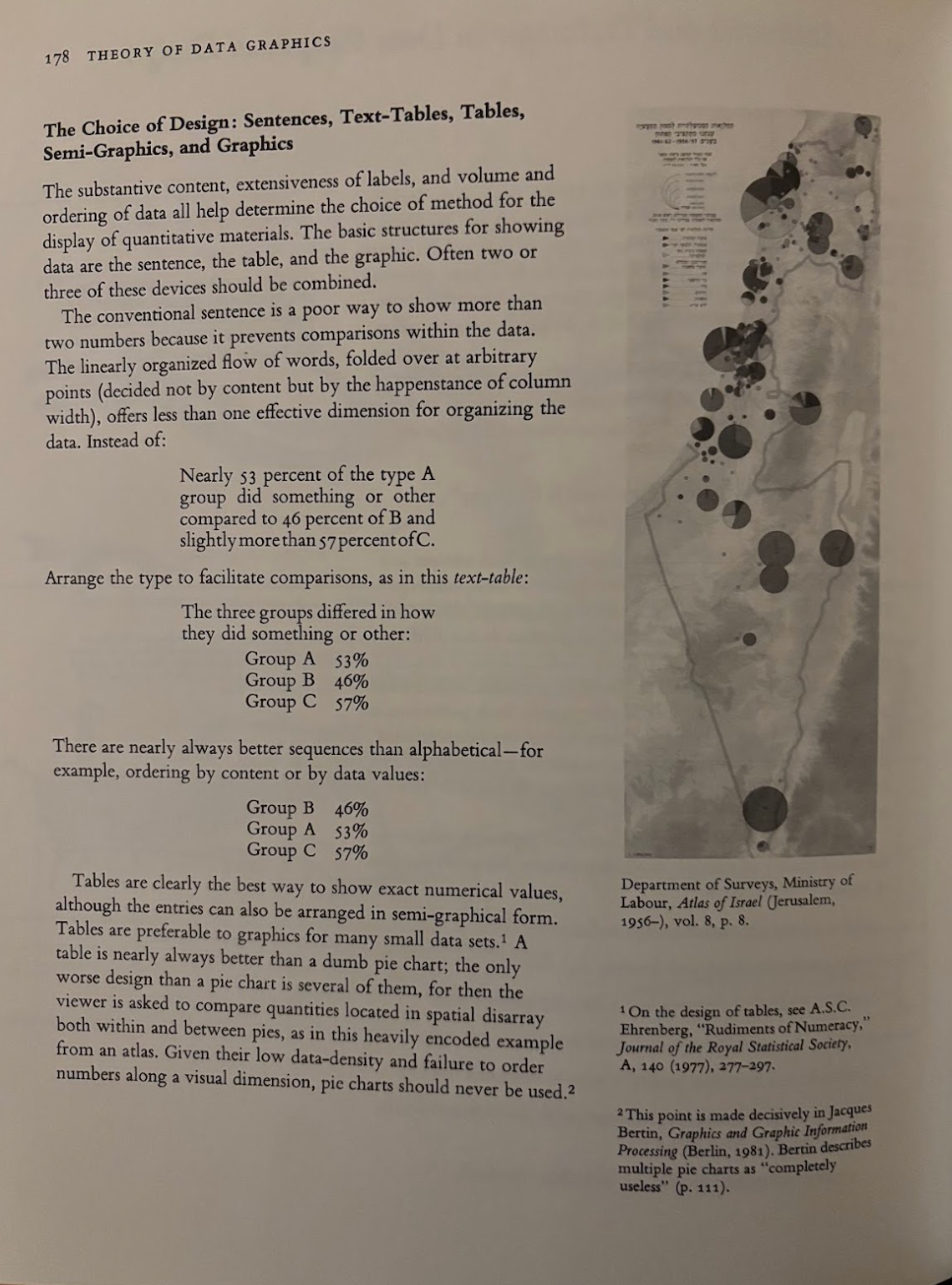
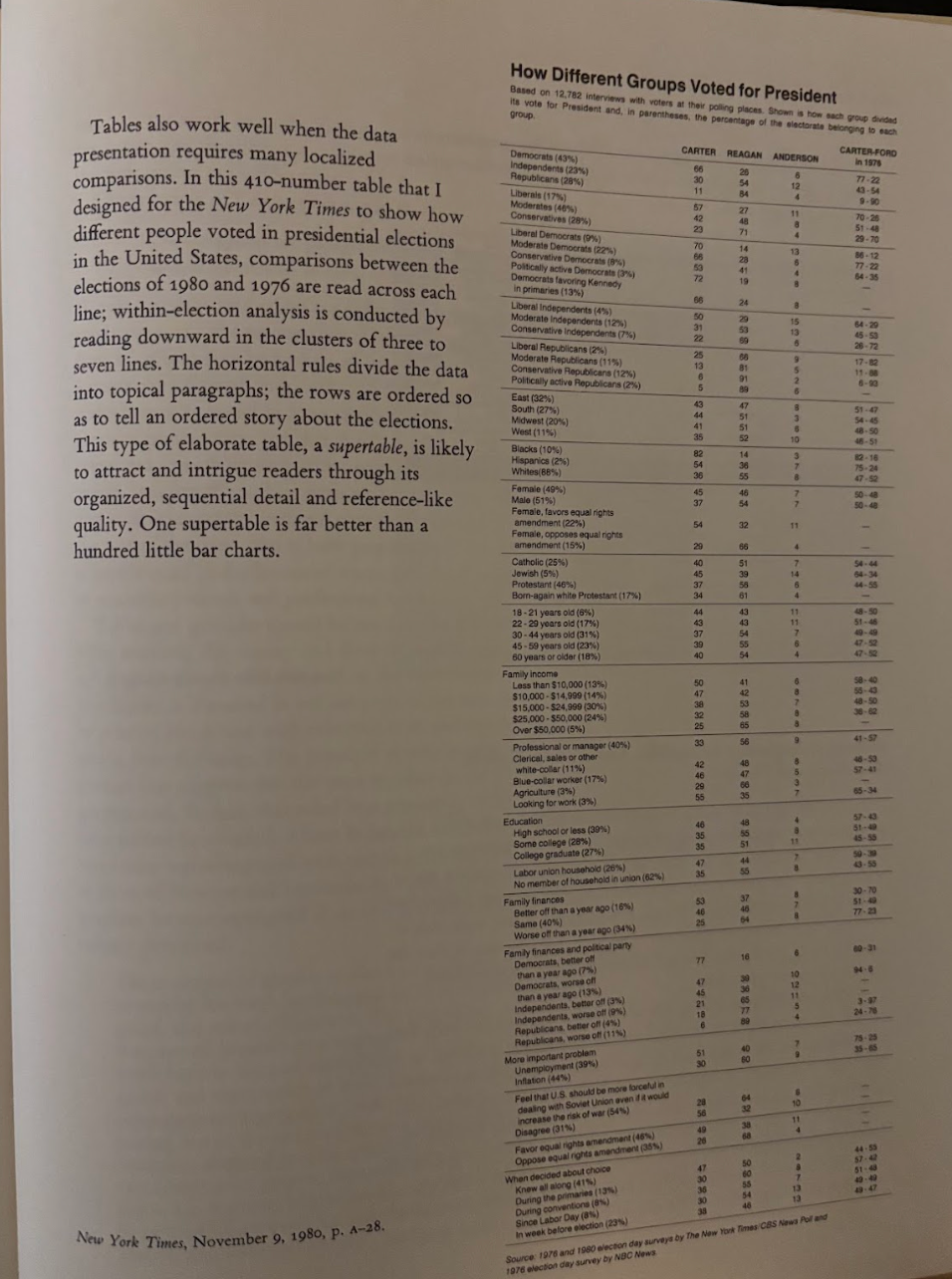
I remember the first time I read an Edward Tufte book, and early on, he said something like "if you look at the top of the next page, you'll see a picture." It blew my mind.
Writers never say things like that. Writers usually don't control what their book's final formatting will look like, so they don't know where their pictures will end up. They don't want to risk saying "look at the top of the next page" only to have the picture end up at the bottom of this page, or at the bottom of the next page, or at the back of the book, or in the middle in an insert printed on thick paper, or in a link in the ebook, or... You get the idea. To be safe, the writer will use the more conventional "look at Figure 1.23".
Tufte was the first writer I read who actually cared about the fact he had written a book. A book qua book, not just a series of words that happened to be printed as a book because binding paper between cardboard is an economically efficient way of delivering information. He cared about what the page size would be, and the font, and where pictures would end up in relation to each other, and how the text should work with the pictures. He pulls every formatting lever a book gives him, whitespace and color and page margins and so so so so many pictures, to deliver his message clearly.
While writing the MID Trilogy, one of my goals is to write an ebook qua ebook. I want to write something that honors and takes advantage of the medium.
A lot of people who attempt this project end up writing choose-your-own-adventure novels. I get why this temptation exists. The internet exists for links; it's literally the H in HTML. It feels natural for an internet-native book to have a lot of links, and it feels natural for a book with a lot of links to let the user choose how to traverse through them. Unfortunately, choose-your-own-adventure novels are bad. It is hard enough to write a single story that works; writing a story with hundreds of paths that work is impossible. Inevitably, most of these paths end up being bad.
I think there are better ways to do for internet writing what Tufte did for books. For example, 17776 and Gwern's website are two gems of internet writing.
Foreground
More practically, when I write this book and think of a cool effect to add to it, I worry "is this actually a cool effect or is this gimmicky?" Different people will draw the boundary in different places, but below are some rules I'm working with for now.
- Color is cheap. Printed books for adults use color very sparingly; I'm guessing this is because colored ink is expensive and inconvenient to add to standard printing processes. That's not true on the internet. A red pixel is just as easy to display as a blue one or a black one or a white one. There is no reason to stick to a monochrome palette if I think a colored one would get my point across better.
- Space is cheap. Again, printed books for adults vary spacing very rarely; I'm guessing this is because it makes different editions (paperback, hardcover, ebooks) more difficult to format. I'm only writing in a single format, so I let myself futz around with spacing.
- Motion is possible. Books are printed, and their words don't move. Screens do nothing but move, and that opens up some fun possibilities: I can animate my book cover, or have text flash on and off the screen. This one has a high potential for being distracting and annoying though.
- Punctuation is a crutch. I think the best writing advice is to write as you speak. People don't use punctuation when they speak, so I look at punctuation as a necessary evil. Punctuation makes writing clearer, but it is not sacred, and the internet opens up new ways of making writing even clearer. For example, quotation marks are trash and can be replaced by better signals of dialogue-turn-taking. Ellipses are fine, but I also add extra space after each to drive the point home.
- SHOW don't tell. This is common writing advice, and the internet allows me to take it to a new level.
- He whispered: Put the whispered text in a smaller, lighter font.
- They spoke at the same time: Put the text on top of other text.
- Thomas always spoke quickly: Make his text more squished than everyone else's.
- The audience laughed a little bit: Literally show the "ha ha ha"s.
- He remembered when X had said something: Add a link to the time when X actually said it, so readers can go back and re-read that part.