B1C1
Travel
I don't usually insert myself into my stories, BUT...
"I wasn’t that good and I hated traveling." - Clay
"If the slightest bad thing happens to them, like they couldn’t get into the Colosseum on their trip to Rome, it ruins their whole month." - Lyla, in a previous draft
[Clay] had no doubt he would find her feed full of generic travel posts soon, as she followed the rest of the world to Austria in the summer and Argentina in the winter.
I hate travel.
Once upon a time, travel used to be one of many hobbies. People enjoyed gardening, or crosswords, or sure, traveling, and that was fine.
And then something happened, and now travel is the best hobby.
You're taking time off work? Make sure you travel.
You're retiring? Make sure you travel.
You're dying young of a terminal disease? Make sure you travel before you go.
You're a homebody? Call it a staycation and pretend you're traveling.
Imagine a world where instead of travel, social consensus settled on building gingerbread houses as the experience everyone must have. People spend months and thousands of dollars collecting decorations for their gingerbread house. When people take vacations, they spend all day working on their gingerbread house. When people make small talk, they ask each other, "what kind of gingerbread house are you building next?" Wouldn't that world be stupid? This one is too.

The director of Knives Out revealed that one secret to mystery movies is that Apple doesn't allow the murderer to use an iPhone. In a similar vein, I'll tell you the secret to my mystery books. Anyone who likes to travel is a bad guy. Not always a murderer, but definitely a bad guy.
Speaking of Knives Out, here's a review of those movies
When I was doing the research for this review, I came up with a lot of theories. Many of them are half-baked, but I want to put the one I feel most confident about first because I’m really proud of it.
Towards the end of Knives Out, the main character receives an email from 092832@protonmail.com.
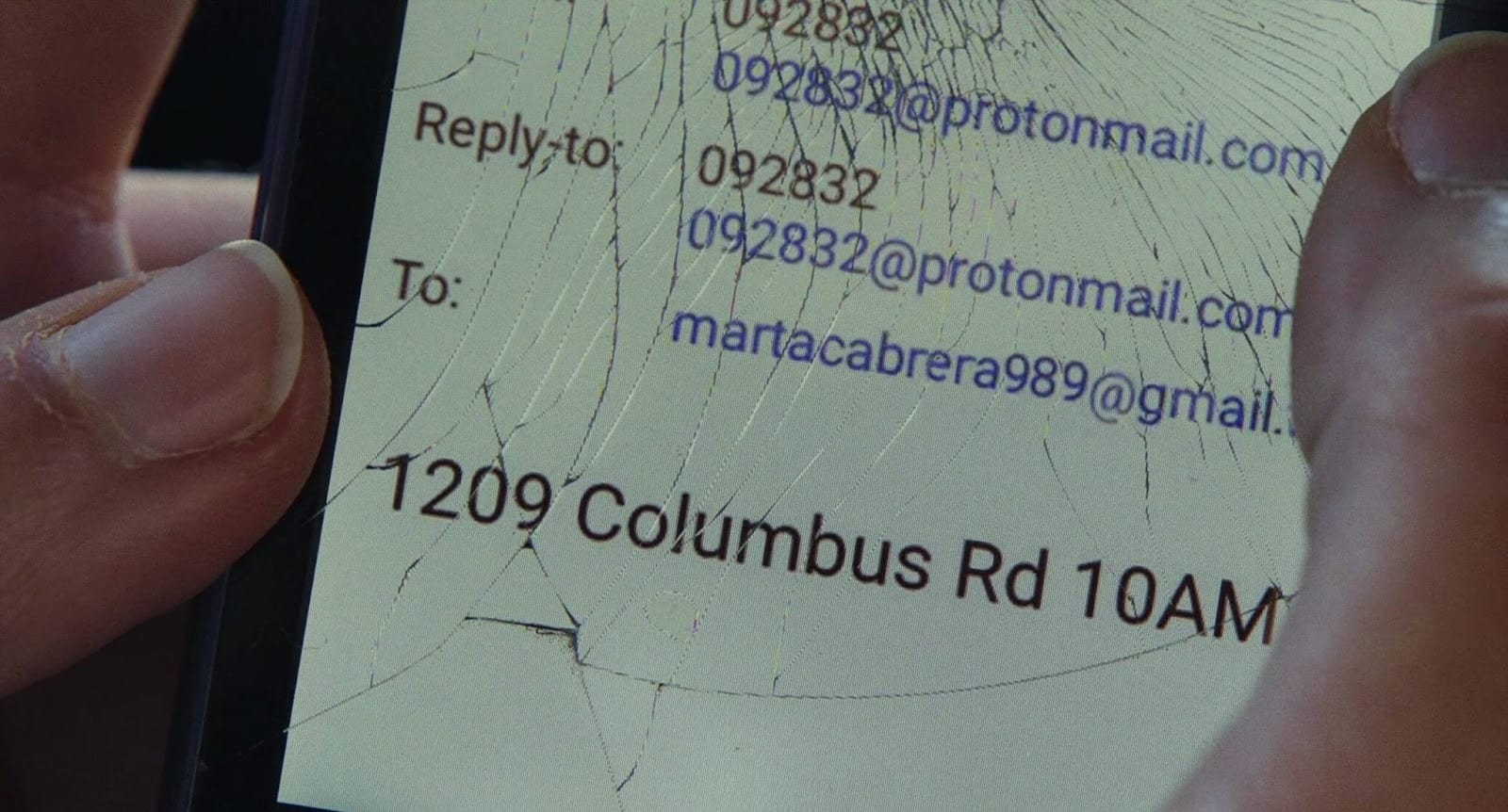
No one on the internet seems to care about this email address, except for this one guy, and even he didn’t try to figure out what it meant. I did. I believe this is a reference to the director, Rian Johnson’s, first hit movie, Looper. Looper was released on September (09) 28 (28), 2012 (20 + 12 = 32). Just to drive the point home, the address (1209) again references September 2012.
That’s my li’l detective moment; everything that follows is full of spurious speculation and spoilers about Knives Out.
Ask not whodunit
Knives Out is, at its bookends, a classic whodunit (we’ll get into its unconventional middle later). A rich old man dies in a luxurious country home filled with his nearest and dearest, all of whom had a reason to kill him. The last person to see him alive was his nurse who, it turns out, also inherits his whole fortune. A brilliant detective, Benoit Blanc, investigates. The nurse is the primary suspect for most of the movie, but at the end, Blanc points the finger at the playboy grandson. Curtain.
This is a book clearly inspired by Agatha Christie. It is so inspired by Christie that Johnson acknowledged the detective is meant to be an American Poirot. It is so inspired by Christie that the title font literally traces text from Christie’s book covers.
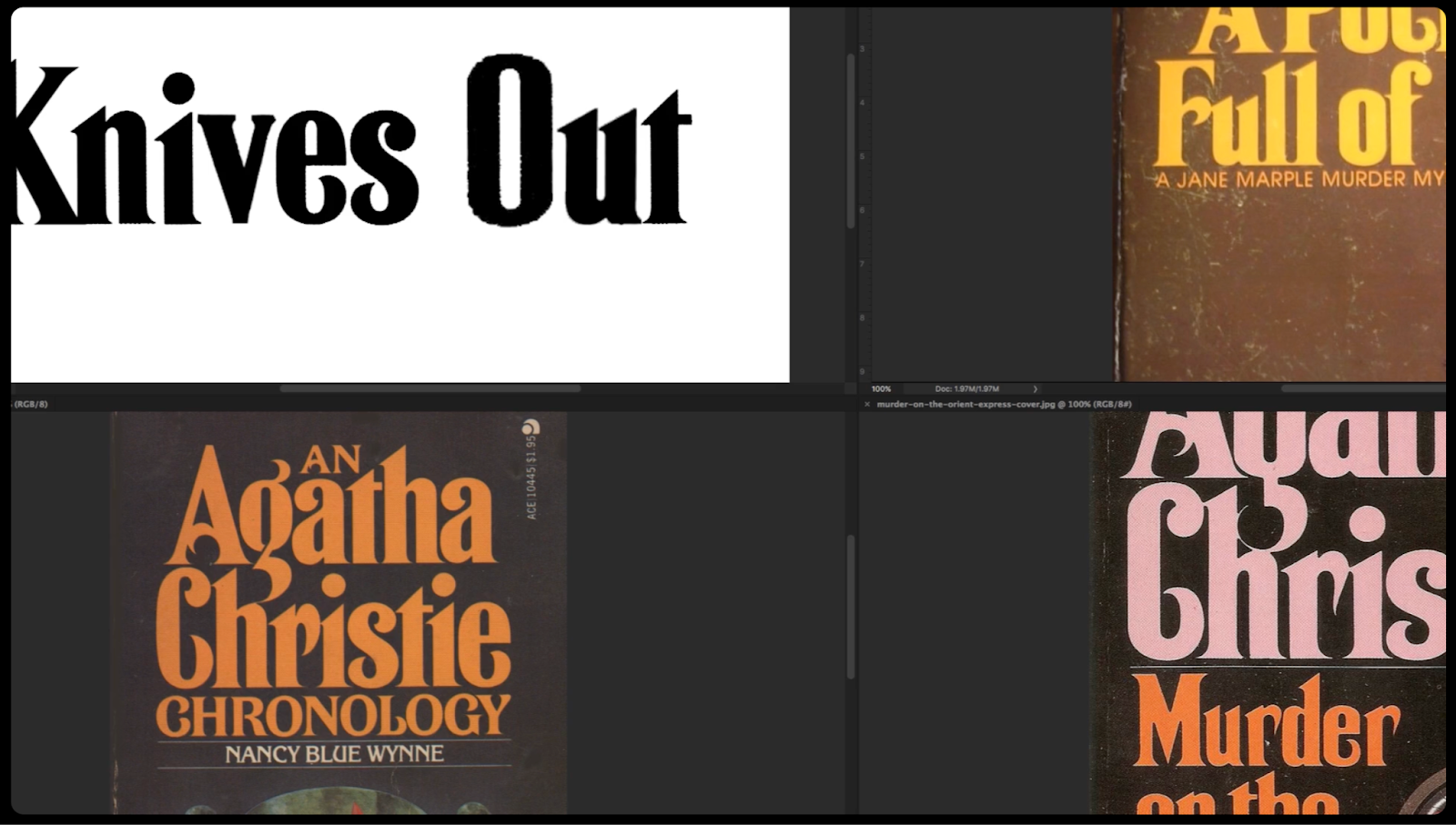
If you’ve ever read a Christie novel, you might have noticed that on the first or second page, it says something like “Outsold only by the Bible and Shakespeare, Agatha Christie is the best-selling novelist of all time.” This is a bonkers fact! The list of most popular English-language writers apparently goes:
- God
- The guy who invented modern English
- A genre-fiction girlie who wrote guilty pleasures
Selling that many books is no easy feat. How did she do it?
The obvious answer is “she wrote good mysteries.” This is wrong. The dirty little secret of most mysteries is that the mystery part could be compressed into a short story. Sherlock Holmes solved the vast majority of his mysteries in short stories. So did Father Brown and Encyclopedia Brown (no relation). I’ll grant you that Christie writes good mysteries, but why do people enjoy the other 150ish pages in each novel?
It’s because Christie’s tales are moral fables. A death sets the stage, but the heart of the story is the judgment the detective casts on the living.
A lot of people think that Christie’s tales are moral fables because her detective, Poirot, catches the bad guy at the end. This is incorrect. The whole point of a mystery novel is that there is not just one bad guy! For a mystery novel to be interesting, almost everyone we meet must be a plausible suspect who was willing to kill.
These stories take place in a world where a powerful figure has been evil and careless for a long time, and in doing so, has made a lot of enemies. This evil central figure warps the souls of everyone around him until they are a little evil too, whether to thrive or merely survive. Despite the popular stereotype, the butler almost never does it in these books. The suspects are friends and family of the evil central figure, because those are the people most firmly ensnared in his web. Finally, one of them snaps and kills.
In the aftermath of the murder, Poirot steps into the shoes of the murdered evil figure, and becomes the central figure who holds power over all the suspects’ lives. Only, unlike the evil figure, Poirot is good. Poirot only wants to right old wrongs; he makes no further demands of the suspects.
And once Poirot solves the case, he doesn’t just j’accuse the killer. He calls out the evil every single suspect holds in their heart. All the assholes get their comeuppance. This part of the book is incredibly satisfying; almost more satisfying than the mystery itself. No wonder Christie sells like the Bible; they’re both books about how awesome Judgment Day is.
Knives Out is so good because it is also a moral fable first and mystery last.
One set of characters in this moral fable are the rich victim’s three children. They are bad because they are all greedy and selfish nepo-babies, although each of them puts their own twist on it.
- The daughter started a real estate business with a huge loan from her dad.
- The son manages his dad’s publishing empire.
- The daughter-in-law (her husband, the other son, is dead) gets living expenses from her father-in-law.
Ask yourself, why three kids? In the real world, the answer would be “their parents liked kids” or “birth control didn’t work out” but this is not the real world. Why did the writer create three kids, not two or four? Because the three kids fill out the three bad quadrants in the below plot.
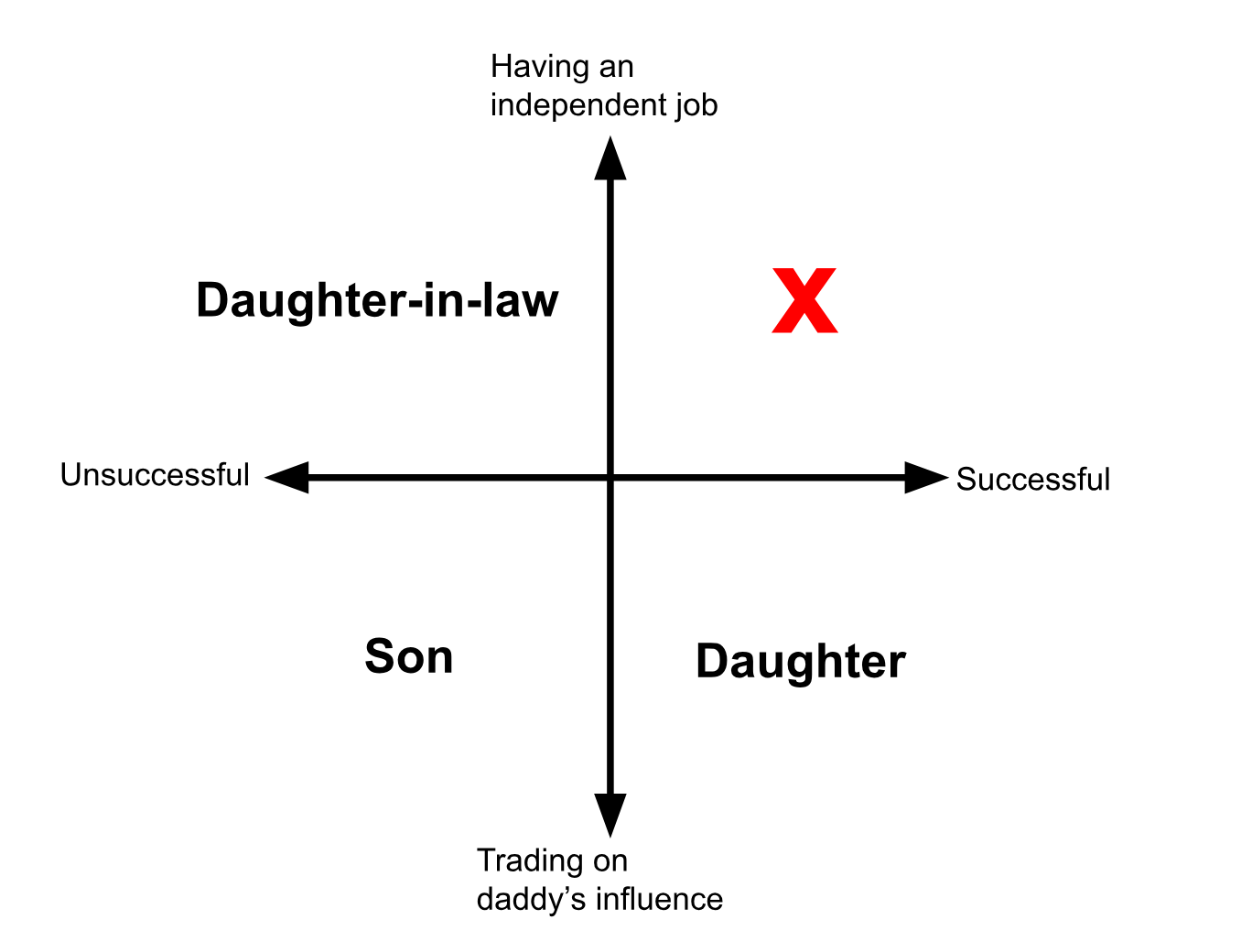
If there was a fourth kid, to be a unique character, he would need to be both successful and doing his own thing, which would make him a worthy heir to his dad, which would make the nurse redundant, which would make the story fail.
The nurse is the good counterpart to the three failkids. She is competent and nice and likes to spend time with the rich man without an eye on his money.
There are three grandkids too. Again, in real life, you’d ask “Why only three? It’s surprising that each couple didn’t have the standard 1.8 kids.” But the movie only needs two grandkids to fill out extremes on the left-right political spectrum: social justice warrior and neo-Nazi. The third grandchild is the killer, and he is not tied to an archetype so that he can do what the plot needs him to do for the murder to make sense.
The delicious climax of the movie is not when Blanc reveals who did it. It’s when Blanc protects the nurse from the vicious family and tells them off for being assholes. There are several clues to this.
First, the only time Blanc utters the words “knives out” in the movie is not in reference to the dead guy found with a knife in his hand, but in reference to how the family has treated the nurse. Blanc yells at them that they are “a pack of vultures at the feast, knives out, beaks bloody.” Interestingly, in the script, the phrase “knives out” was used in reference to the murder, but Johnson clearly realized during shooting that the heart of the story was not the murder.
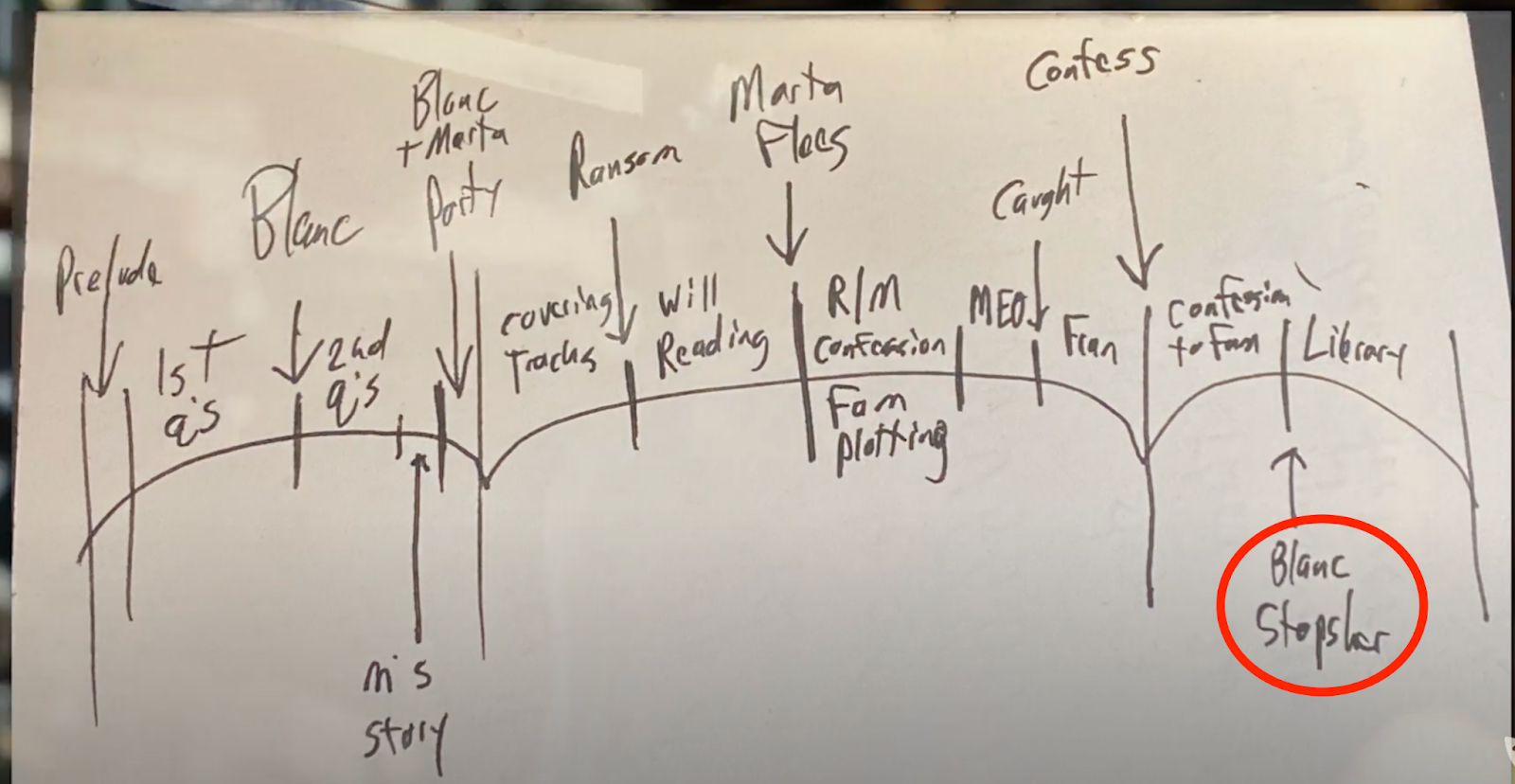
Second, Johnson’s own sketch of the movie’s structure shows that the high point of the third act is when Blanc defends the nurse from the family (“Blanc stops her”, circled in red) and not the denouement where he solves the mystery (“Library”).
Third, the ending of the movie focuses not on Blanc, or on the killer getting led off to jail, but on the nurse finally enjoying her newfound wealth and looking down at the selfish family that mistreated her.
It’s this moral fable quality that made Knives Out (and Christie) so popular. Without this, they would have been mildly successful genre tales. With it, they are knockouts.
However, the actual plot of Knives Out isn’t even the most interesting moral fable associated with it.
Star Wars 2: Electric Boogaloo
In the winter of 2019, moviegoers got to witness a plucky band of misfit friends go up against a massive and powerful adversary, and against all odds, win. I'm not talking about Star Wars.
The Goliath in this story is The Mouse, Ruler of the Magic Kingdom, Commander of Copyrights, Victor of The Streaming Wars, Protector of Childhood Nostalgia, long may he reign.
The David in this David v. Goliath story is Johnson, accompanied by his Knives Out collaborators, who are all some combination of cousins and people he has known for decades.
Why did they battle?
It all started a long time ago in a galaxy far, far away, when Disney acquired Star Wars IP and released the first Star Wars movie in more than thirty years. The good news is that the movie recaptured all the magic of the first movie, A New Hope. The bad news is that the movie recaptured everything from A New Hope; it was a straight retelling with new characters. Rian Johnson, fresh off the success of Looper, was brought on to write and direct the next movie.
Here retellings diverge based on who you ask. Johnson’s sequel was not a straight retelling of a previous movie. It was original. Critics appreciated the originality; audiences were more divided. Because Star Wars has a passionate fanbase, Johnson was loudly and thoroughly critiqued. The key word that floated around the internet a lot at this time was “subvert.” As in, “Rian Johnson subverted audience expectations” and “go subvert your fucking face Rian.”
Johnson did what he did because he spotted what probably every writer for Star Wars has spotted: the stories are trapped by nostalgia. As a writer for the first movie said, “It just felt like every time Luke came in and entered the movie, he just took it over. Suddenly you didn’t care about your main character anymore because, ‘Oh fuck, Luke Skywalker’s here. I want to see what he’s going to do.’” It’s genuinely hard to write a movie when the audience doesn’t care about the main character! Johnson tried his best to mixed results, and the people who came after him completely shat the bed.
The next Star Wars movie, The Rise of Skywalker, is the only Star Wars movie I’ve ever seen. Because I was visiting a Star Wars superfan at the time, I actually saw it premiere weekend at the Disney-owned theater on Hollywood Boulevard. They had all sorts of goodies for fans: stormtroopers to take pictures with, someone playing the soundtrack on an organ, an exhibition with costumes from the movie, free Star Wars posters. I was surrounded by excited fans, many in costumes, the whole time. It should have been a really fun evening.
Except that the movie was so, so bad. It was so bad that my friend spent the rest of our vacation typing out essays on his phone about how bad the movie was. It was so bad that for a month or two after, I went into a rabbit hole of watching dozens of YouTube videos about the movie, because I really just wanted to understand how an anticipated movie from a celebrated franchise could be so dogshit.
Thankfully, that’s not the only movie I watched that winter. I also watched this little mystery movie I’d been hearing really good things about: Knives Out. It was a wonderful palate cleanser. It made me want to write a mystery novel myself (this one! the one you're reading!).
Think about how Johnson must have felt watching The Rise of Skywalker crash and burn because his successors did an even worse job dealing with the nostalgia trap than he did. All while his movie made bank, he got nominated for his first Oscar, and he was now helming one of the hottest franchises around. And the best part? He did it by subverting the whodunit.
Mysthrillerery
Whodunits make for boring movies. There are too many characters to pay attention to; each character has their own motive and alibi and lies and relationships; the clues are all finicky things like a key that opens an unknown lock, a neighbor who overheard a conversation, an invoice with unexpected items, fingerprints missing from a prescription bottle, or an earring without a matching pair. As Johnson said, audiences think puzzle-based whodunits are “overly theatrical, fussy, and belabored,” more a math problem than a rollercoaster ride. For example, did you spot that the list of clues above spells K-N-I-F-E? If not, you’re NGMI.
In his interviews and the director’s commentary, Johnson talks over and over again about how he needed to keep the audience engaged, even though the whodunit format doesn’t naturally lend itself to engagement. The format works on paper, but movies are a different medium with different requirements.
The first thing Johnson did to make the movie interesting was to simplify, simplify, simplify.
- You know how I talked about the rich victim’s three children above? He cut out most of the scenes that describe their individual motivations, and instead simplified them into a single “rich greedy kids” blob. The original script has many scrapped details like how one of them was shot in the leg by a loan shark, and the other one is being sued for selling lotions that cause horrible rashes.
- He removed a lot of the conversations that attempted to fill in plot holes, like answers to questions like: “Shit. Why would they test his blood?” and “How did Harlan miss this?” and “So wait, if the police know this, why am I not in jail?” This stuff just bores and confuses the audience; we want to float along on vibes instead.
- He cut out many of Blanc’s dialogues, like a monologue about aging and grief and a worldbuilding dialogue about his cat in the city. Blanc does get to keep his long “donut hole” speech during the denouement, but even that was a close call, and Johnson only kept it in full because the actor delivered a terrific performance.
- One of the keys to the movie is that the nurse mixes up two bottles of medicines. Johnson spent a lot of time writing and rewriting this part to make the explanation for the mix up as simple as possible, eventually landing at the foolproof solution of having the bottles fall to the ground and roll around.
In short, Johnson’s attitude to whodunit affeccionados’ expectations that the plot have intricately woven clues and red herrings can be summed up by what his nurse character says while playing Go: “I’m not playing to beat you, I’m playing to build a beautiful pattern.”
However, mere simplification is still not enough. Like sharks smell a drop of blood in the ocean, general audiences can smell a drop of complication in a plot. This is why, before the first act is even over, Johnson solves the mystery for the audience. We learn that the nurse, who is otherwise a very sympathetic and nice character, accidentally killed the rich man by mixing up his medicines. Instead of a whodunit, we’re suddenly watching a thriller, where we’re rooting for the nurse to escape as the detective casts his net.
To make the movie even simpler, the nurse is given a made-up medical condition that makes her throw up everytime she lies. She can’t lie to make up an alibi, or plant a clue, or throw a false accusation at someone else. In other words, she can’t create any of the traditional whodunit complications.
It’s still not enough; making the plot simple doesn’t solve the other, bigger problem. The center of a classic whodunit is its godlike detective. As a superhuman being, his thoughts are hidden and incomprehensible to mere mortals; he does not go through a character arc. He exists, catalyzes the plot, and judges. This doesn’t work well on screen.
BBC’s recent Sherlock adaptation got around this by adding lots of textual confetti to the screen to make Sherlock’s thoughts comprehensible.
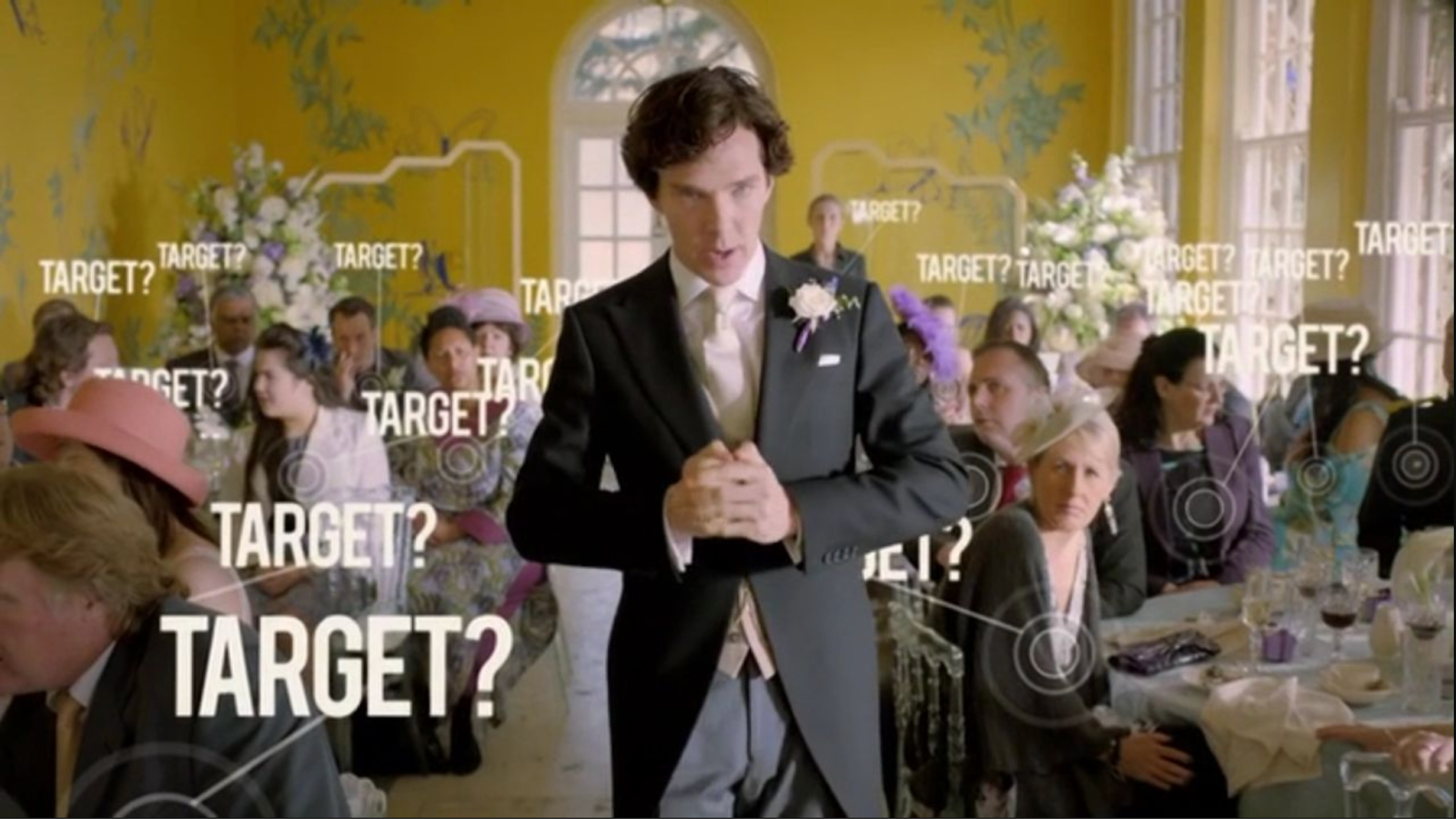
Johnson gets around this by making Blanc kinda… dumb?
I hate to say this, but I’m afraid it’s true.
- He enlists the nurse to help him solve the case, without first checking how much money she stands to inherit (and thus what motivations she may have).
- He lets the nurse tramp around in footprints from the night of the murder, destroying that evidence.
- He lets the nurse erase a tape from a security camera, destroying that evidence.
- He doesn’t notice the nurse throwing away a piece of a broken trellis behind his back, hiding that evidence.
The original script did have quite a few moments of brilliance from Blanc. For example, at one point, he tests an influencer family member’s lotion brand on himself to check if it actually works. At another point, he semi-mystically detects that the victim’s ancient mother has something to say to him, and arrives at her side exactly when she speaks about an important clue. All these moments are left on the cutting room floor.
You see, the thriller part of the movie only works if we’re in genuine suspense about whether the nurse will get away with her crime or not. If Blanc were godlike, or even merely hypercompetent, there would be no suspense. For the movie to work, the audience needs to be genuinely unsure whether Blanc is an observant detective or a blundering fool.
The writer taketh away, and the writer giveth. Blanc may not be a classic godlike detective, but he does have a very fun accent. If you’ve watched the movie, you’ll know that Blanc’s primary character trait is having a strong Southern accent. This was not always so; in the original script, his accent was described as “gentlest southern lilt you’ve ever heard in your life.” On screen, it is, as a grandchild memorably puts it, a “Kentucky Fried Foghorn Leghorn Drawwwwwl.” For example, “I did a little poking” from the script becomes “I’ve been doin’ a little pokin’” in the captions.
Even as the movie adaptation fixes flaws in the whodunit structure, it introduces a few of its own. Most prominently, gur zheqrere’f tbggn or gur frpbaq crefba ba gur pnyy furrg, evtug? (Rot13 this only if you are okay with likely spoiling the next movie, coming out this November, for yourself.) But also, how to make a sequel work? Whodunit plots are fairly repeatable, but Knives Out took out almost everything that makes them so.
Knives Out 2: Electric Boogaloo
The first thing you notice about Glass Onion, the sequel to Knives Out, is that it is a victory lap. This movie is opulent as hell. It has a Beatles song playing over its end credits. It was filmed at a luxurious Greek resort villa that has a 1:1 ratio of guests to staff. There are actual special effects!
Also, the cast is stacked. Just considering cameos alone, the first ten minutes include Stephen Sondheim, Kareem Abdul-Jabbar, and Yo-Yo Ma. The first movie’s press interviews were filled with anecdotes like “Daniel was ready to join but wasn’t sure when he would have time for it, and then luckily his Bond movie got pushed back” and “Chris Evans wasn’t going to join until he realized he could shoot in his hometown of Boston.” This time around, the anecdotes are more like “I wasn’t sure Serena Williams would say yes, but then I asked her, and she was so excited.”
But maybe the most opulent thing about this movie is that it actually contains a whodunit. This time around, Johnson isn’t worried that he will bore the audience if he adds too many motives or clues. He leans into the little finicky details, trusting that, thanks to Knives Out, the audience is predisposed to liking him enough to be patient with him.
We get four main suspects, who echo the victim’s kids from Knives Out, except this time they aren’t compressed into a single “rich greedy people” blob. Getting into the weeds:
- We have Claire and Lionel, who despite not being married, give off the same energy as the real estate daughter and her husband from the first movie. Both sets of characters are the most successful and respectable ones in their circles. Both sets of characters owe the start of their success to a rich guy.
- Birdie and the daughter-in-law would be best friends if they knew each other. Both are flighty and frivolous influencers who hawk shitty wares (sweatpants and makeup respectively). Both are probably into crystals and aligning chakras. Both have daughter-figures much more serious and down-to-earth than them.
- Duke and the unsuccessful son are both weak men who overcompensate for their weakness by getting mixed up in unsavory bullshit (right-wing influencing and borrowing from a loan shark respectively). Both are interested in starting an online media empire.
- They’re not suspects, but Helen and the nurse are both main characters that belong to marginalized groups and are the only nice people in their circles. In a sign of the times, 2019’s Knives Out has an immigrant nurse with an undocumented mother and 2022’s Glass Onion has a brilliant Black woman.
Even though the two sets of characters are similar, the Glass Onion characters have way more depth. We find out classic whodunit information like (1) what they were doing before they met the rich guy at the center of this story, (2) how the rich guy helped them become famous, and (3) why their relationship with the rich guy is currently strained.
This time around, Johnson doesn’t solve the movie in the first act either. Instead, he sets up clues onscreen for the careful watcher to find. To take just one example, one of the questions surrounding the murder is “where did the victim’s cell phone go?” Consider these two screenshots taken about 15 seconds apart:
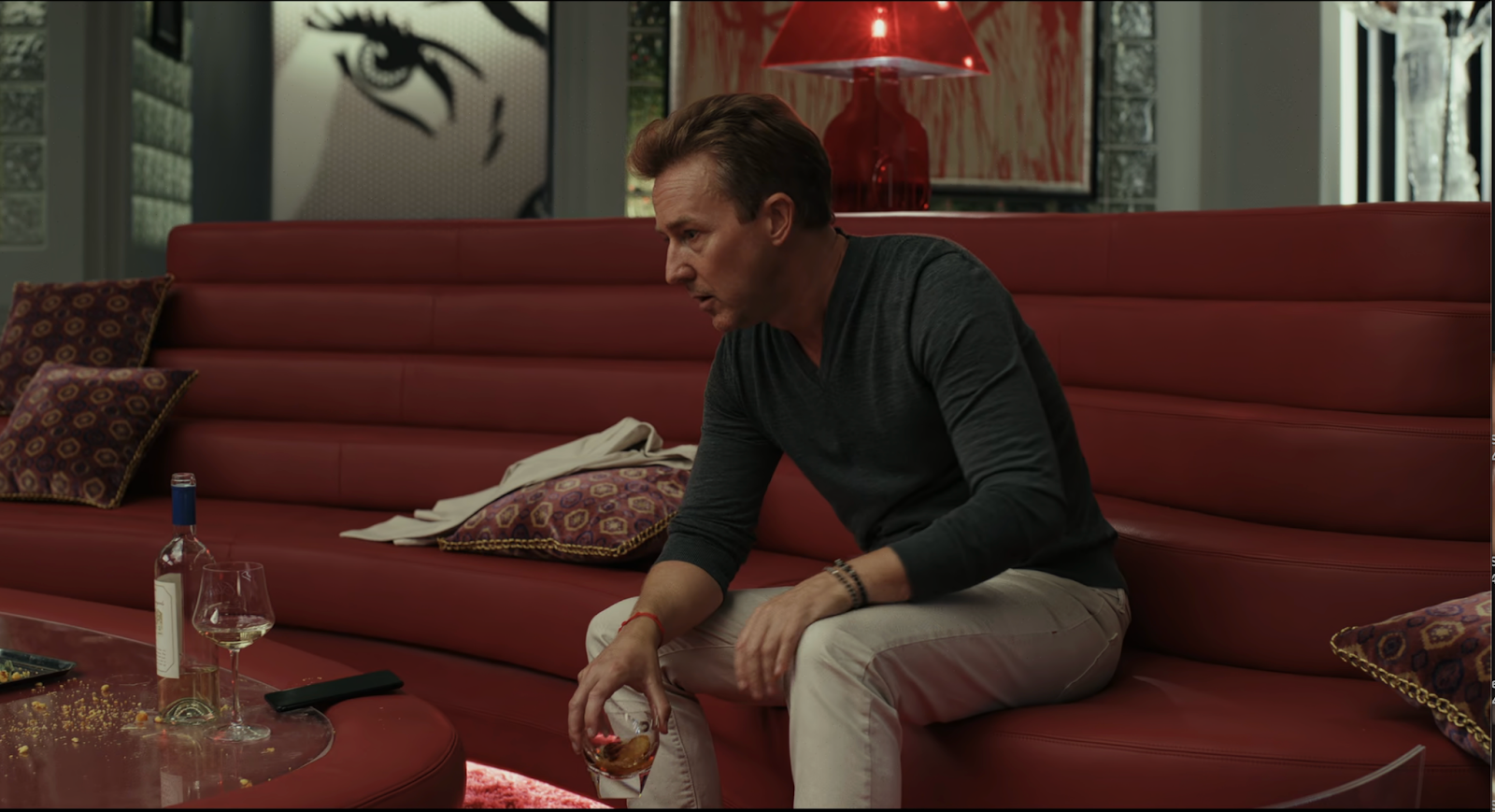
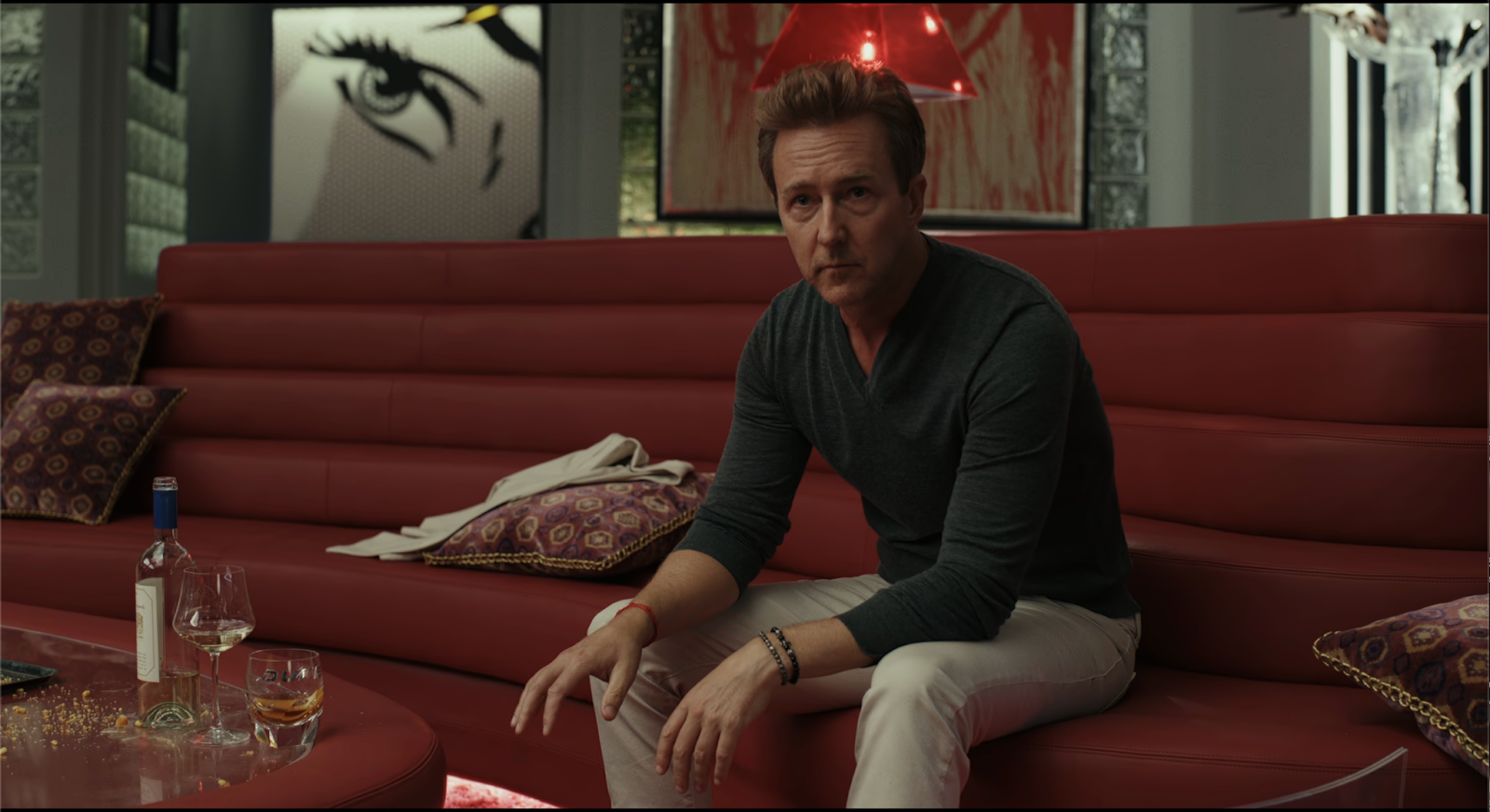
In the fifteen seconds between those two screenshots, the guy has pocketed the phone that was on the table. It seems like the kind of continuity error that seems destined to end up in the “Goofs” section on IMDb, but no, it’s a real clue.
There is attention to making the clues realistic too. For example, there is a scene where a silhouetted character shoots another. Johnson shoots the silhouette of the actual character who does the shooting, and then blurs it to keep the audience guessing. This is a marked change from a similar scene in Knives Out, when we are supposed to be seeing the silhouette of the nurse dressed as a man. When Johnson filmed this scene, he realized that the nurse still looked like a small woman despite her getup, and instead of scrapping that scene because the clue didn’t work, he filmed a male stunt double in the getup instead. This time, Johnson doesn’t use movie magic to fudge the clues; we get an honest-to-god fair play mystery that an observant viewer could solve.
Because Knives Out was such a success, Johnson is no longer bound by the need to simplify his plot so he doesn’t lose his audience. Unfortunately, that doesn’t mean he is free of constraints altogether. The other constraint is much trickier to solve: the detective still sucks as a main character. “A movie about a semi-omniscient being who never grows as a character” is just a long-winded way of saying “flop.”
So the detective is still not at the center of this story. The main character this time is a simple Southern woman who wants to catch her sister’s murderer. She makes for a much better main character because she has a compelling and sympathetic motivation, and can grow in response to adversity.
However, for her story arc to make sense and be compelling, she has to be where the action is. To get to where the action is, she has to dress up as her dead sister and go to a private island owned by her dead sister’s nemesis. Oh, also, this island is hosting a bunch of other people who hated her dead sister, one of them to the extent of killing her. Blanc not only allows her to do this, he is the person who suggests this idea to her! This is crazy!
Blanc is supposed to be the last of the gentlemen detectives. Why would a gentleman detective put his client in the middle of this kind of danger? Blanc says it is because he won’t be able to get the necessary information out of people otherwise but… uh, sir, you’re supposed to be a professional detective. Do your damn job.
Similarly, at the end of the movie, Blanc hands the woman a dangerous explosive, and strongly encourages her to use it. You see, Blanc has found no real proof that the bad man committed a murder, and so, in lieu of digging more, he encourages the woman to literally blow it all up.
Again, from a storywriting perspective, this makes sense. The woman is the main character. The movie is only fun to watch if she has agency and saves herself. Blanc saving her would be boring, and involve too many words besides. Her saving herself is fun, and she can do it by literally blowing shit up, which looks great onscreen.

But… What kind of a responsible gentleman detective would nudge his client to set off an explosion that big? Keep in mind that the same client, and several innocent bystanders, are still in that building that just blew up! Of course movie magic makes sure no one dies, or even gets hurt beyond a singed eyebrow or two, but come on!
For all the realism of the clues and the characters, the climax is ludicrous.
Not to mention, the climax doesn’t end with just that explosion. The freaking MONA LISA also ends up burning for reasons not worth explaining here except to say, come on!
I’m not a Star Wars fan, so I had no idea why those losers kept whining about subverting Luke’s character or whatever. However, I am a whodunit fan, and I am not enjoying my unflappable, godlike, gentlemen detectives being subverted like this.
My brain understands that the classic detective won’t translate well to screen, and because the medium is the message or whatever, instead of a measured speech, an onscreen climax must involve projectile vomit or explosions or some other shit. Fine. I get it. I hate it, but I can understand it. I like the movies, but I'd rather write a book.